What is egg traceability and how EggLink does it
Every egg sold in the EU carries a code. What egg traceability means, what the EU rules ask of packing centres, and how EggLink keeps the whole trail.

Every egg sold in the EU has a short code printed on the shell, something like 1-PL-12345678. It tells you which farm the egg came from. Everything else, from the lay date to the buyer, lives in the records kept along the way. Egg traceability is those records, joined up.
What egg traceability means
EU food law asks every business in the chain to know who supplied it and who it supplied, usually summed up as “one step back, one step forward”. For a packing centre that means knowing which farm and lay date every delivery came from, what it was graded and packed into, and which buyer got it. When something goes wrong, those links lead back to the source, and only the affected eggs come off the shelves.
How to read an egg code
- The first digit is the farming method: 0 organic, 1 free range, 2 barn, 3 cages.
- Two letters for the country where the farm is registered, such as PL, DE or NL.
- The farm’s registration number. In Poland that’s the farm’s veterinary number.
So 1-PL-12345678 is a free-range egg from one registered farm in Poland. Nothing on the shell says when it was laid, where it was packed or who bought it.
The EU rules, in plain words
- General Food Law (Regulation 178/2002). Know your suppliers and your buyers. If you have reason to think food you sold is unsafe, withdraw or recall it and tell the authorities.
- Food of animal origin (Regulation 931/2011). For every delivery: what, how much, from whom, to whom, the lot and the dispatch date, ready for the authorities without undue delay.
- Marketing standards (Regulation 2023/2465). Class A eggs are graded, stamped and packed within 10 days of laying, and the pack shows the packing centre code, class, weight grade and best-before date.
- Packing centre records (Regulation 2023/2466). Daily and by farming method: eggs received per producer with producer code and lay date, graded output, and deliveries per buyer. Kept for at least 12 months and shown on first request.
- Best-before (Regulation 853/2004). At most 28 days after laying.
- Salmonella (Regulation 2160/2003). Eggs from an infected or suspect flock can’t be sold as table eggs. They’re marked Class B and go to industry.
Why eggs are a special case
Most fresh food can be traced to a crate or a lot. Eggs are different:
- Every egg is marked. Each shell names its farm, even on a loose egg.
- Many farms meet at one grader. A large packing centre grades over a million eggs a day from many hen houses, each kept apart.
- The clock is short. Ten days to pack, 28 days to best-before.
- Risk sits with the flock. A salmonella result applies to one hen house, sometimes backdated, and you need exactly those eggs, wherever they are now.
How EggLink keeps the trail
The legal duty stays with the packing centre. EggLink keeps the records linked and finds them in seconds.
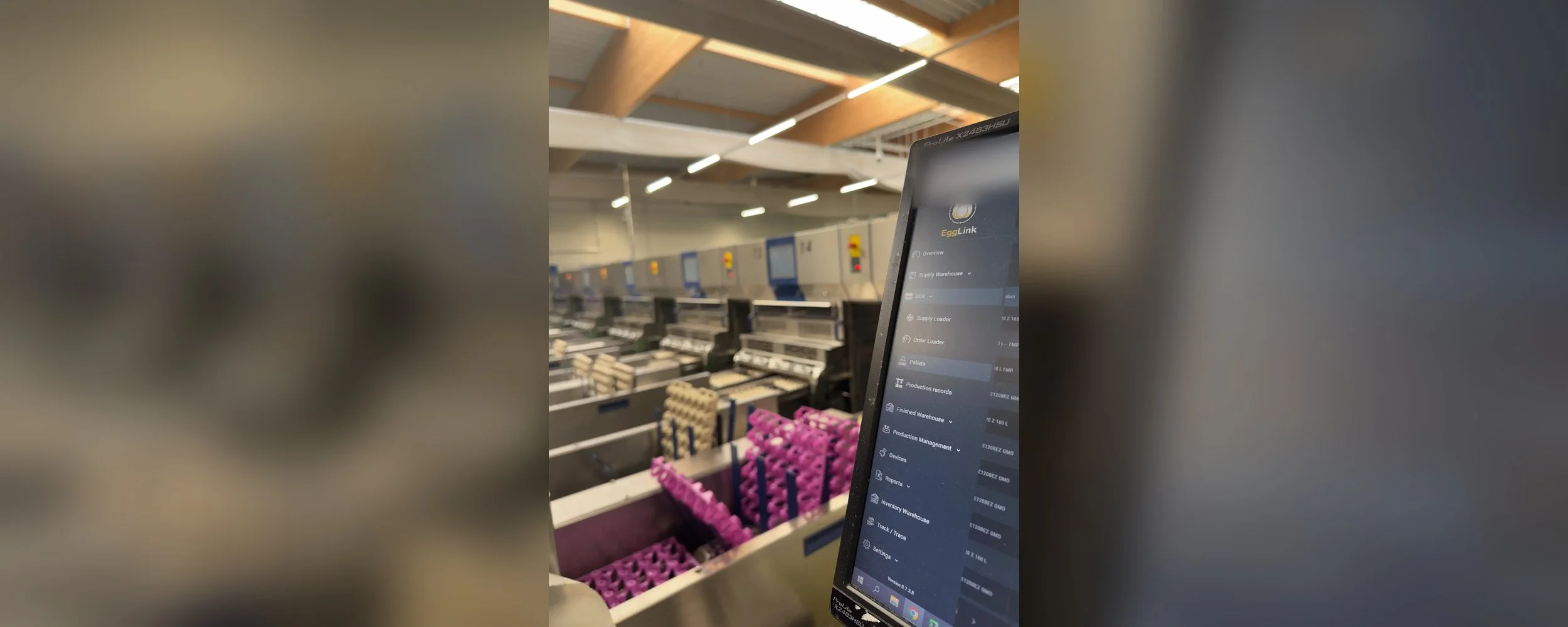
- Receiving. Each supply pallet is recorded with supplier, hen house, producer code, lay date and quantity. Deliveries from a blocked supplier or restricted flock are refused, as are eggs booked under the wrong farming method.
- Warehouse. Split, merge or blend a pallet, and the link to every hen house and lay date inside stays.
- Grading. Only single-source Class A pallets that trace back to a receipt can be loaded, and their producer code and lay date go to the grader.
- Packs, cases and pallets. Each pack gets its own printed code, separate from the stamp on the eggs, tied to its order, supply, machine and lane. Cases link to their packs, pallets to their grading runs, and pallets carry GS1 SSCC labels.
- Trace and recall. Scan any pack, case, pallet or SSCC code to see where the eggs came from and where they went. Or start from a farm and lay dates and trace forwards or backwards, blended pallets included. A recall flags every matching pallet still in the plant, and each is then released with a reason, returned to the supplier or kept blocked.
- Salmonella. Restrict a flock from the date of the vet result, even a past one, with names recorded. Downgrade packed stock to Class B if the result comes in late.
- Records. Every stock movement stores when it happened, who did it and why. Corrections point to the original instead of overwriting it.
See it on our egg grading page, or get in touch to watch a trace from pack back to farm.